Greenhouse farming: choosing the structure, controlling the climate and starting right
A greenhouse lets you grow when and where open fields cannot, but only if the structure, the climate control and the crop plan fit your conditions. This guide covers each decision in the order you will face it.
In this article
- What greenhouse farming is, and when it pays
- Types of greenhouses
- Greenhouse covers: film, nets and glass
- Keeping a greenhouse cool in hot climates
- Crops that do well, starting with greenhouse tomatoes
- Irrigation and fertigation in a greenhouse
- Pest control: screens first, then IPM
- Greenhouse farming in Kenya, Nigeria and the Gulf: what changes
- How to start greenhouse farming, step by step
- What drives greenhouse cost
- Common greenhouse farming mistakes
- Frequently asked questions
What greenhouse farming is, and when it pays
Greenhouse farming means growing crops under a cover that changes the climate around them: warmer in the cold season, sheltered from rain, wind and hail, and closed against many pests. The usual goal is to grow beyond the open-field season and sell when prices are better.
The most commonly grown greenhouse crops are vegetables with medium heat needs: tomato, pepper, cucumber, melon, watermelon, marrow, green bean and eggplant. FAO's guide for Mediterranean climates notes that these species are adapted to average temperatures of 17 to 28 °C, with limits around 12 °C minimum and 32 °C maximum.
That range is the key to whether a greenhouse pays. FAO is blunt about it: growing in places without suitable climate conditions is highly questionable, because it means expensive artificial climate control. Before choosing a structure, ask how much heating or cooling your site will need to stay near that range, and whether your crop's price covers it.
Types of greenhouses
The right structure depends on your climate. FAO points out that in a humid tropical climate, protection from rain is the main purpose, while in semi-desert or Mediterranean regions the design must deal with heat and strong sun.
| Type | What it is | Strengths | Watch out for |
|---|---|---|---|
| Tunnel (single span) | Curved steel or pipe hoops covered with plastic film | Low cost, quick to build, easy to move | Limited height and ventilation, heats up fast |
| Multi-span plastic greenhouse | Several connected arched spans, usually galvanized steel with film on the roof | Larger growing area, roof vents, easier to add cooling and control | Condensation dripping from the roof in cold, humid weather |
| Net house (screenhouse, shade net) | A frame covered with insect or shade netting instead of film | Shade and wind protection, keeps out many pests, low heat build-up | Little warming, does not keep rain out |
| Glasshouse | Rigid frame with glass panels | Long life and high light | High investment, best suited to cold climates |
FAO notes that glasshouses are the usual structure in the cold north but are not popular in southern regions because of their cost. In warm countries, plastic tunnels, multi-span plastic houses and net houses do most of the work.
Greenhouse covers: film, nets and glass
Polyethylene film is the standard cover. FAO gives a thickness range of 80 to 200 microns for greenhouse films, with multilayer films (often three layers) preferred in commercial production because they combine strength with optical properties. UConn Extension adds that greenhouse grade film is sold in 6 mil (about 150 microns), contains a UV stabilizer and is warranted for 4 years or more, while cheaper co-poly is good for one season.
Additives change how the film behaves:
- UV stabilizer slows the breakdown caused by sun and heat.
- Infrared (thermal) additive keeps radiant heat inside on cold nights.
- Anti-condensate makes water run down the film instead of dripping on plants.
- Light diffusion spreads light more evenly through the canopy.
Each additive costs some light. UConn gives typical light transmission of 88 to 91 percent for UV stabilized film and 82 to 87 percent for IR and anti-condensate film. Keep films clean, since dust also cuts the light that reaches the crop.
Nets replace film in net houses or cover the vents of a closed greenhouse. Glass and rigid panels last longest but cost the most.
Keeping a greenhouse cool in hot climates
In hot, sunny regions, heat is the main problem. FAO lists three ways to deal with it: let in less sun, move hot air out, and turn heat into evaporation.
Ventilation
Vents in the roof, side walls and gables let hot air escape. FAO cites a recommended total vent area of 15 to 30 percent of the floor area; above 30 percent, extra vent area adds very little cooling. Exhaust fans give higher air exchange when natural ventilation is not enough.
Shading and whitewash
Shade cloths, coloured nets, reflective screens and white paint on the roof all reduce the sun coming in. Whitewashing is common around the Mediterranean because it is cheap and, unlike internal shade nets, does not block roof vents. FAO calls shading the last resort, because less light also means less yield.
Evaporative cooling: pad and fan, or fog
Evaporative cooling lowers the temperature and the dryness of the air at the same time, and FAO notes it works best in dry environments, which makes it a strong fit for the Gulf and other arid regions.
- Pad and fan. Fans pull or push outside air through wet pads. FAO suggests pads about 200 mm thick, roughly 1 m² of pad per 20 to 30 m² of greenhouse, no more than 40 m from pad to fan, and a basic airflow of 120 to 150 m³ per m² of greenhouse per hour. Turn the water on before the fans, and switch the fans off before the water.
- Fog or mist. Fine nozzles spray water high in the greenhouse. FAO notes the climate is more uniform than with pads, without the need for an airtight house.
For best results, combine cooling with shading.
Crops that do well, starting with greenhouse tomatoes
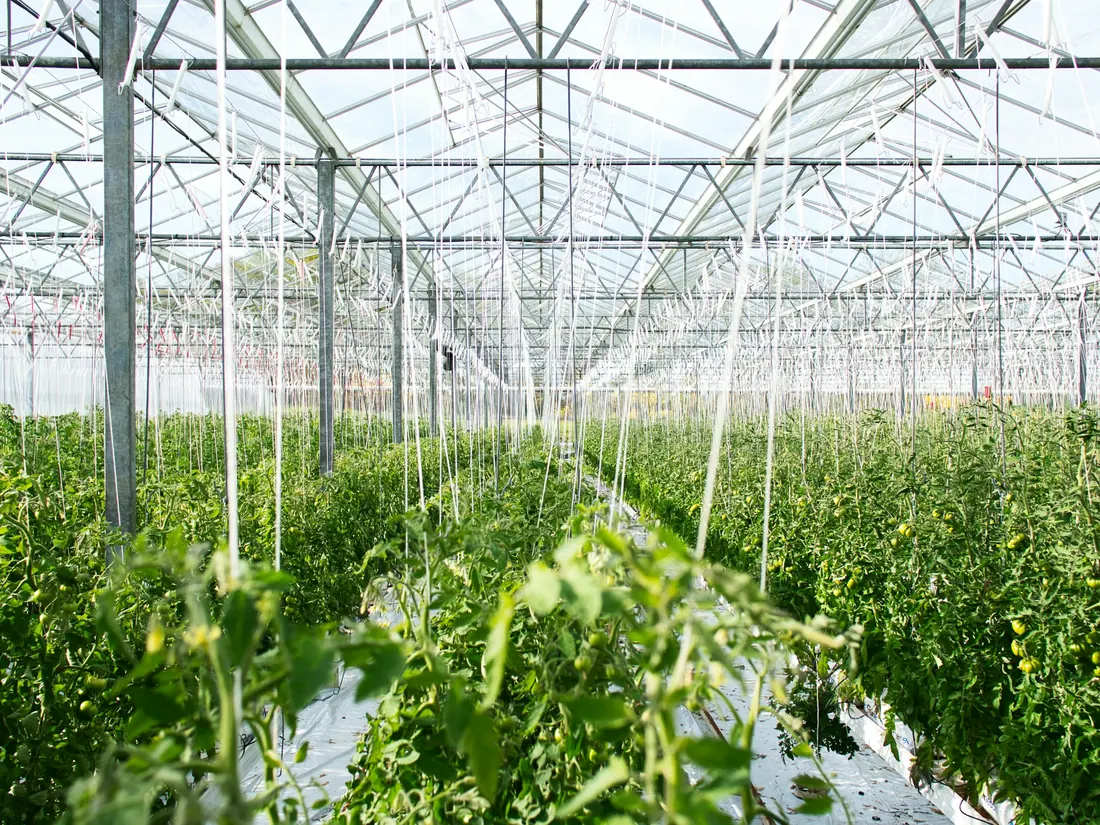
Tomato is one of the most widely grown greenhouse crops, alongside pepper and cucumber. A few points decide a good tomato crop:
- Temperature. When growers manage by 24-hour average temperature, FAO advises keeping tomato between about 15 °C and 30 °C, with a day to night difference of 5 to 7 °C. Rutgers notes that fruit set drops when days go above 90 °F (32 °C) and nights above 70 °F (21 °C).
- Pollination. In a closed greenhouse, flowers need help: mechanical vibration or bumblebees, as FAO describes.
- Training. Indeterminate varieties are grown up strings and pruned to one or two stems to use the height of the house.
- Variety. Choose varieties bred for greenhouse use with resistance to the diseases and viruses present in your area.
Irrigation and fertigation in a greenhouse
Most commercial greenhouses use drip irrigation, because it puts water at the roots, keeps leaves dry and lets you feed the crop through the same lines. Our guide to the drip irrigation system explains filters, pressure and maintenance in detail.
Plan nutrition from a soil or substrate test. Base phosphate goes in before planting, then nitrogen, potassium, calcium and magnesium are split through the season according to crop stage. Our guides on DAP fertilizer and triple super phosphate cover base phosphate choices.
Pest control: screens first, then IPM
Vents are the main door for insects. FAO's figures for screen openings:
| Pest | Screen opening that keeps it out |
|---|---|
| Thrips | 0.15 mm |
| Whitefly and aphids | 0.35 mm |
| Leafminers | 0.8 mm |
FAO describes whitefly-proof 50 mesh woven screens as the most efficient barrier against Bemisia tabaci, a whitefly about 0.2 mm wide that spreads tomato yellow leaf curl virus. The trade-off is airflow: fine screens slow ventilation and raise temperature and humidity, so screened houses need more vent area or fans.
Screens exclude most pests but never all. Integrated pest management adds the rest: a double door entrance, yellow and blue sticky traps to monitor, clean planting material, removing crop residues, biological control where available, and targeted sprays only when monitoring shows a need. Tomato growers should watch closely for Tuta absoluta, the tomato leafminer, which FAO records spreading to North Africa in 2008 and on to the Near East.
Greenhouse farming in Kenya, Nigeria and the Gulf: what changes
The principles are the same everywhere; the climate decides which ones matter most.
- Humid tropics, such as much of southern Nigeria and coastal East Africa. Rain protection and ventilation come first. High humidity favours leaf diseases, so tall structures with large vents, or net houses, often work better than closed houses.
- Highlands, such as parts of central Kenya. Days can be warm and nights cool, so films with thermal additives and good night management help, along with ventilation for sunny afternoons.
- Arid and desert climates, such as the Gulf. Strong sun and heat dominate. Shading plus pad and fan or fog cooling is the usual answer, and water quality matters because drip systems and crops are sensitive to salts.
How to start greenhouse farming, step by step
- Pick the crop and the market first. Know who buys, in which months and at what quality.
- Check the site. Sun exposure, wind, drainage, road access, power and, above all, the amount and quality of water.
- Test soil and water for salinity, pH and nutrients, and check for soil-borne diseases if the land was farmed before.
- Choose the structure that fits your climate and budget: tunnel, multi-span or net house.
- Plan climate control: vents, shading, cooling and, if nights are cold, heating or thermal screens.
- Design irrigation and fertigation with proper filtration.
- Set up pest exclusion before the first crop: screens, double doors, traps.
- Start with a trial area if you are new to greenhouse growing, then scale up.
- Keep records of temperatures, water, fertilizer, pests and yields from day one.
What drives greenhouse cost
Costs vary too much by country and supplier for a single figure to be useful. These are the factors that move the budget:
- Structure type and size. Steel gauge, height, span width and wind or snow rating.
- Cover. Film grade and additives, nets, or rigid panels, and how often they must be replaced.
- Climate control. Vents and screens cost little; pad and fan systems, fogging, heating and controllers cost much more and use energy and water to run.
- Irrigation and water treatment, including filters, tanks and, where water is saline, treatment.
- Site work, levelling, drainage, roads and power connection.
- Running costs: labour, seeds or seedlings, fertilizers, crop protection, energy and maintenance.
Common greenhouse farming mistakes
- Building first and choosing the crop and buyer later.
- A closed house with too little ventilation in a hot climate.
- Fine insect screens added without extra vent area or fans, so the crop cooks.
- Skipping the water test, then fighting salts and clogged drippers.
- No double door, so pests walk in with every worker.
- Starting at full scale with no greenhouse experience.
If you want a project like this planned and run for you, from land preparation to harvest, see our turnkey farm projects or read about Adès Agro on our homepage.
Frequently asked questions
Is greenhouse farming profitable?
It can be, when the crop, the market and the climate fit. FAO warns that growing where the climate is unsuitable needs expensive climate control, so the economics of the site decide. Start from the buyer and the price, then check your heating or cooling needs.
What is the best greenhouse for a hot climate?
A tall structure with large vents, shading and evaporative cooling. FAO recommends a vent area of 15 to 30 percent of the floor area and notes that evaporative cooling is most efficient in dry air. In humid tropics, net houses or well ventilated tall tunnels often work better than closed houses.
How thick should greenhouse plastic be?
FAO gives a range of 80 to 200 microns for greenhouse films. Greenhouse grade film of 6 mil (about 150 microns) with a UV stabilizer is warranted for 4 years or more according to UConn Extension, while thin co-poly lasts about one season.
What temperature do greenhouse tomatoes need?
FAO advises keeping the 24-hour average between about 15 °C and 30 °C, with a day to night difference of 5 to 7 °C. Rutgers notes poor fruit set when days exceed 32 °C and nights exceed 21 °C.
What mesh keeps whitefly out of a greenhouse?
FAO describes 50 mesh woven screens as the most efficient barrier against whitefly, and gives a 0.35 mm opening for whitefly and aphids and 0.15 mm for thrips. Finer screens reduce airflow, so add vent area or fans.